EB-5 Investor Readiness Guide
To countless global investors, the United States serves as a land of immense opportunity, a foundation for new beginnings, and a secure setting for their families. However, the path to permanent residency frequently resembles navigating a complex and intricate maze. This is where the EB-5 Immigrant Investor Program enters the picture, serving as a reliable compass for those seeking to make a meaningful investment in the U.S. economy in exchange for the prestigious copyright. For investors investigating your options for U.S. immigration, this complete overview is designed to answer your questions and clarify the path forward. We will explore the specifics of the program, from the first steps to the last stages of securing permanent residency, using the framework provided by U.S. Citizenship and Immigration Services (USCIS) to ensure you have the most accurate and reliable information at your fingertips.
Essential Takeaways
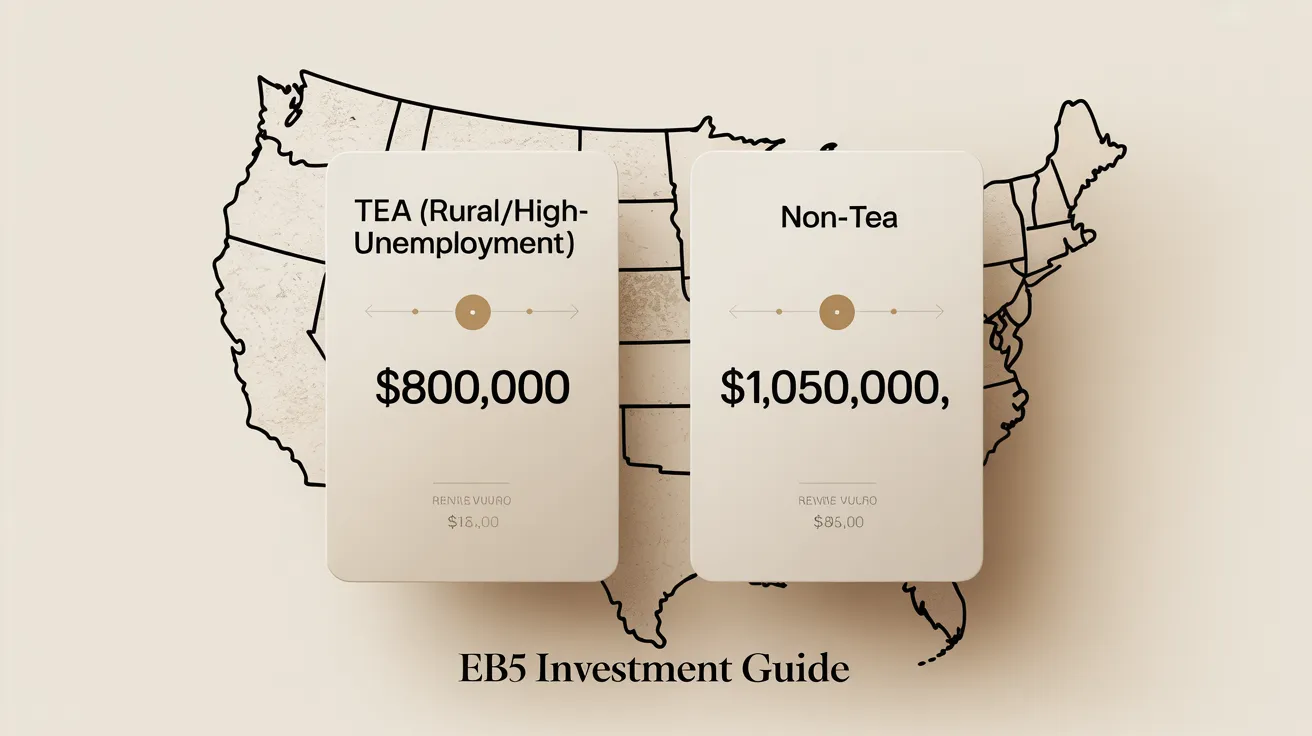
- The EB-5 program provides a secure pathway to getting a U.S. copyright through investment, requiring an investment of $800,000 in TEA designated regions or $1,050,000 in non-TEA locations.
- The procedure requires completing Form I-526/I-526E, obtaining a two-year Conditional copyright, and subsequently submitting Form I-829 to lift conditions.
- Investment seekers have the opportunity to choose between a managed investment option through a Regional Center or a hands-on direct investment approach.
- Complete verification of the legal origin of money serves as a key factor affecting positive petition outcomes.
- Individuals applying from heavily impacted regions might experience processing delays and must check the Visa Bulletin for updates on priority dates.
- This opportunity grants permanent residency for the investor and their family members, with an option to U.S. citizenship after a five-year period.
The Complete Guide to the EB-5 copyright by Investment
The EB-5 copyright by investment goes beyond being just a visa; it serves as a gateway to a fresh start in the United States. Managed by USCIS, the program was designed to stimulate the U.S. economy through investment and employment generation by foreign investors. In exchange for their contribution, investors, as well as their spouses and unmarried children under 21, can obtain a copyright, granting them the opportunity to study, live, and work anywhere in the country. This approach stands as one of the most dependable routes to permanent residency, as it doesn't need sponsorship from a family member or an employer, providing a measure of freedom that is highly attractive to global entrepreneurs and investors.
The EB-5 investment program represents proof of America's devotion to economic development via international investment. Different from other immigration pathways that rely on family connections or employment sponsorship, the EB-5 pathway empowers investors to direct their immigration destiny through purposeful capital investment. This self-directed approach appeals to successful business professionals and entrepreneurs who opt to utilize their own monetary assets rather than third-party sponsors.
Breaking Down the EB-5 Investment Threshold
At the foundation of the EB-5 program exists the investment component. The required capital contribution is not a one-size-fits-all figure; it varies based on the specific area of the investment project where you place your capital. Understanding these financial requirements represents the fundamental and crucial phase in your EB-5 process. USCIS has implemented two distinct investment levels that demonstrate the economic development goals of the United States federal government.
Analyzing the Two Tiers: $800,000 vs. $1,050,000
An investor must contribute at least $800,000 when investing in ventures situated in a Targeted Employment Area (TEA). On the other hand, the required investment increases to $1,050,000 for projects situated outside of these special regions. The investment thresholds are purposeful; they are strategically determined to guide capital into high-priority locations, and the difference is significant enough to make the investment location a key decision factor.
The investment thresholds were established with specific purpose to channel foreign capital into economically disadvantaged regions. The $250,000 disparity between TEA and non-TEA investments serves as a considerable incentive that can influence investment choices and general investment approach. Investors should diligently consider not only the monetary aspects but also the sustained feasibility and employment generation prospects of projects in various locations.
Strategic Positioning: Understanding Targeted Employment Areas (TEA)
A key element of a Targeted Employment Area (TEA) serves as a fundamental component of the EB-5 program. A TEA is defined as either a rural area or an area experiencing high unemployment, specifically areas with unemployment rates of at least 150% of the national average. The lower investment threshold of $800,000 for projects within TEAs serves as a compelling motivation designed to channel foreign capital into communities that have the greatest need for economic development and job creation.
When it comes to selecting a TEA-based project, there's more than just minimizing the capital outlay; these projects can also provide advantages like quicker application handling and excellent opportunities for satisfying the program's stringent job-creation standards. Selecting a project within a TEA can thus become a critical decision that shapes the entire path of your EB-5 visa copyright application. Since TEA designations are carefully monitored and updated periodically, it's crucial for investors to validate present designation before finalizing any project.
Starting Your Path to America: Submitting Form I-526/I-526E
After identifying your investment project, the formal procedure for pursuing your EB-5 visa starts with the submission of either Form I-526 or Form I-526E for Regional Center participation. This petition to USCIS needs to comprehensively show that your investment meets all EB-5 program criteria. This encompasses not only contributing the mandatory investment funds but also providing a detailed plan outlining how the investment will generate a minimum of 10 full-time jobs for qualified U.S. employees.
The I-526/I-526E application serves as the foundation of your complete EB-5 petition. Each following phase in the process depends on the completeness and accuracy of this initial petition. The application must deliver a convincing business case that establishes not only compliance with program requirements but also the viability and sustainability of the planned job creation. USCIS adjudicators examine these petitions with significant attention to detail, making thorough preparation fundamentally necessary.
Understanding Source of Funds: Verifying Your Legitimacy
A vital component of the I-526/I-526E petition is the verification of the lawful source of your investment funds. USCIS maintains considerable focus on this portion of the application, and you are required to furnish a detailed and precise documentation of the derivation of your capital. This necessitates furnishing extensive financial documentation, namely bank statements, tax returns, and verification of property sales or other transactions, to create a definitive and unbroken chain of documentation that your funds were obtained through proper means.
The completeness of your source of funds documentation can significantly impact the success of your petition. USCIS demands complete traceability of funds from where they originated through every transaction leading to the EB-5 investment. This documentation has to detail monetary exchanges, intermediate transfers, and any loans or gifts involved in building the investment amount. The complexity of this requirement typically requires partnering with qualified specialists who understand the specific documentation standards required by USCIS.
The Investment Journey: Choosing On a Regional Center and Direct Investment
The popular EB-5 immigrant investor program features two distinct pathways for investors: making an investment via a USCIS-approved Regional Center or pursuing a direct investment into a new commercial enterprise. Deciding between these approaches will depend on your individual objectives, your desired level of involvement, and your comfort with risk. Each route presents specific pros and cons that should be thoroughly assessed in the context of your particular situation and goals.
A Regional Center functions as an economic entity, whether public or private, that works toward fostering economic development. Regional Centers are widely favored as they allow a less active investment strategy, pooling funds from various investors and managing projects on their behalf. Additionally, they offer more flexible job creation requirements, allowing the incorporation of secondary and induced job creation in addition to direct employment. This comprehensive job creation approach can make it easier to meet the program's employment requirements.
A direct investment, conversely, calls for a higher degree of participation, where the investor is actively involved in the management of the business. This pathway delivers enhanced control but also demands a higher level of management involvement. Direct investments have to prove job creation through direct employment only, which can be more challenging but also easier to verify and validate. The choice between these routes should correspond to your investment strategy, capacity for engagement, and level of confidence with various investment risks.
Understanding Your Two-Year Conditional copyright Journey
Upon approval of your Form I-526/I-526E petition and as soon as a visa is available according to the Visa Bulletin, you and your qualified dependents will be issued a Conditional copyright, which remains valid for a period of two years. This represents a major milestone, allowing you to live in the U.S. and commence your new life. Yet, as the name implies, this status is conditional and comes with specific responsibilities that must be fulfilled to keep your legal status.
Over this two-year timeframe, your investment money must continue to be fully invested and at risk in the project, and the project must proceed toward satisfying the job creation requirements. This phase serves as a testing period, in which you must demonstrate your sustained commitment to the conditions of the EB-5 program. The provisional status of this status means that failure to meet program requirements can cause the loss of your copyright and probable removal from the United States.
Living as a conditional resident provides most of the benefits of permanent residency, including the opportunity to work, travel, and access certain government services. Nevertheless, the conditional status establishes ongoing compliance obligations that demand thorough documentation and oversight. Investors must maintain detailed records of their investment performance, job creation metrics, and adherence to residency guidelines throughout the conditional timeframe.
Achieving copyright: Your Guide to Form I-829
To convert from a conditional resident to an unconditional copyright, you must file Form I-829, the application to remove conditions on permanent residency. This petition must be filed during the 90-day period prior to the two-year anniversary of your admission to the U.S. as a conditional resident. The I-829 petition is the final step in showing that you have fulfilled all the conditions of the EB-5 program.
You must demonstrate that your investment continued throughout the two-year provisional term and that the specified 10 full-time jobs for U.S. workers were generated or sustained because of your investment. Once approved your I-829 petition, the conditions on your copyright will be eliminated, and you will obtain copyright status. This indicates the completion of your EB-5 journey and the attainment of your objective of acquiring permanent U.S. residency through investment.
The I-829 submission needs extensive documentation demonstrating compliance with every program requirement throughout the conditional residency. This encompasses financial statements showing maintained investment, workforce documentation proving job generation, and evidence of the investor's sustained engagement in the business. The comprehensiveness and precision of this evidence directly impacts the likelihood of petition approval and the favorable lifting of conditional residency.
Understanding Backlogs, the Visa Bulletin, and Priority Dates: The Virtue of Patience
For applicants from countries heavily pursuing EB-5 visas, including China, India, and Vietnam, the journey to obtaining an investment copyright USA can entail a substantial waiting period. This is attributed to the annual per-country visa caps set by the U.S. Congress, which cap the number of visas that can be granted to nationals of any single country at 7% of the total annual distribution for each visa category.
When you submit your I-526 petition, you receive a "Priority Date," which basically establishes your position in the line. The Visa Bulletin, updated each month by the U.S. Department of State, delivers details on visa availability and follows the progression of priority dates for respective region. You will need to review the Visa Bulletin to follow the advancement of priority dates and to understand when a visa becomes obtainable to you.
As the traditional wisdom tells us, "patience is a virtue," and this is particularly relevant for EB-5 investors from oversubscribed countries. It is vital to incorporate these potential waiting times into your future strategy and to acknowledge that the immigration process could require several years from initiation to completion. An experienced EB-5 visa attorney can deliver crucial support in handling these intricacies and implementing strategies to handle the waiting period effectively.
Discovering New Possibilities: Exploring the Benefits and Advantages of the EB-5 Program
Notwithstanding the strict prerequisites and possible waiting periods, the EB-5 program provides numerous advantages that make it a popular immigration option. The key perk is the ability for the investor, their spouse, and their unmarried children under 21 to gain permanent residency in the United States. This creates a world of possibilities, including the right to reside, be employed, and pursue education anywhere within in America without requiring a sponsor.
The EB-5 pathway check here delivers unmatched adaptability compared to other immigration pathways. Different from employment-based visas that tie you to a specific company or region, the EB-5 copyright allows total geographic and professional freedom. You have the ability to establish a company, change careers, or continue your studies without immigration limitations. This flexibility is notably beneficial for entrepreneurs and business professionals who prioritize flexibility and autonomy in their career choices.
What's more, after keeping permanent residency for five years, EB-5 investors and their loved ones may qualify to pursue U.S. citizenship, finalizing their journey from investor to American citizen. The path to citizenship through EB-5 is uncomplicated, needing only the continuation of copyright status and fulfillment of standard naturalization requirements. This marks the final realization of the American dream for many international investors and their loved ones.
Questions and Answers
How does the EB-5 copyright process work?
The EB-5 copyright process involves multiple stages for foreign investors to obtain copyright status in the United States. It begins with selecting a qualifying investment project, either a direct investment or through a Regional Center. The investor then files Form I-526 or I-526E with USCIS, furnishing comprehensive evidence of their investment and the lawful source of their funds. Following petition approval and when visas become available, the investor and their family receive a two-year conditional copyright. In this timeframe, the capital investment must remain at risk and create at least 10 U.S. jobs. Finally, the investor files Form I-829 to remove the conditions on their copyright and become a lawful copyright.
What's the minimum investment required for EB-5?
The required investment amount for the EB-5 program is set at $800,000 for projects situated within a Targeted Employment Area (TEA). A TEA is defined as either a high-unemployment region or rural territory. For investments beyond a TEA, the minimum investment requirement is $1,050,000. USCIS establishes these investment levels and are an essential consideration in an investor's decision-making process. The investment must be sustained at risk during the conditional residency period and must be sourced from lawful means with comprehensive documentation.
What constitutes a Targeted Employment Area?
A Targeted Employment Area (TEA) is a geographic location recognized by USCIS that qualifies as either a rural area or an area with an unemployment rate of at least 150% of the national average. The primary purpose of this designation is to promote investment in locations of the country that are most in need. Supporting a TEA-based project allows an EB-5 investor to qualify for the lower investment amount of $800,000. TEA status are based on precise economic and geographic criteria and are revised on a regular basis to account for shifting economic conditions.
What is the difference between a Regional Center and a direct investment?
An EB-5 investor can choose between two investment models: a Regional Center or a direct investment. A Regional Center functions as a USCIS-sanctioned body managing investment projects and aggregates investments from multiple applicants. This is a more passive investment option, as the Regional Center handles the day-to-day management and job creation requirements. Regional Centers may calculate indirect and induced jobs toward the employment requirement. A direct investment requires more active participation where the investor takes direct control of the enterprise management. This option offers more control but also requires more operational responsibility from the investor and must solely rely on direct jobs toward the employment requirement.
What is a Conditional copyright?
A two-year Conditional copyright functions as a temporary, two-year residency permit granted to EB-5 investors when the approval of their I-526 petition and visa allocation. This status allows the investor and their dependents to work and maintain residence in the U.S. Still, the status is temporary subject to the investor fulfilling all EB-5 program requirements, including maintaining their investment and creating the mandated number of jobs. To remove these conditions, the investor must submit Form I-829 before the end of the two-year term. Failure to file on time or fulfill program requirements may lead to loss of status and deportation from the United States.